Operating System (XEOS)
Defines how the enterprise actually runs as autonomy scales—how decisions are made, how work moves, and how control is maintained.
The Problem: Most enterprises are attempting to run 21st-century autonomy on a 20th-century operating system built for human coordination.
This mismatch converts expected leverage into earnings volatility, capital waste, and margin compression.
We diagnose where execution suppresses margin, validate whether capital decisions hold under real conditions, and rewire the enterprise so automation improves earnings—not volatility.
Three components determine whether autonomy improves performance—or introduces volatility.
Enterprises are now executing at machine speed. Performance is determined by whether the operating system can absorb autonomy, whether execution remains stable as it scales, and whether capital decisions are validated against real operating conditions before deployment.
Defines how the enterprise actually runs as autonomy scales—how decisions are made, how work moves, and how control is maintained.
Measures whether execution remains stable as autonomy scales—making visible where drift, latency, fragmentation, and control breakdown are emerging.
Tests whether projected value survives real operating conditions before capital is committed—showing what reaches earnings, what breaks, and where intervention is required.
Capital decisions are only as reliable as the system that executes them.
Boards do not fund transformation plans.
They fund earnings outcomes that will hold under real operating conditions.
Most transformation and AI programs are approved using narrative, benchmarks, and spreadsheet models.
The math may be sound—but it is disconnected from how the enterprise actually operates.
The result is predictable: projected value does not reach earnings.
Most companies model ROI. Xcelerate Innovation models execution reality.
Most capital models assume stable execution:
None of this holds inside a real enterprise.
As transformation and automation scale:
This is why transformation ROI breaks between approval and execution.
These simulations do not model ROI.
They model how the enterprise operating system behaves under change.
Before capital is committed, we quantify:
Every output is:
This is not a projection.
It is how the system will actually perform.
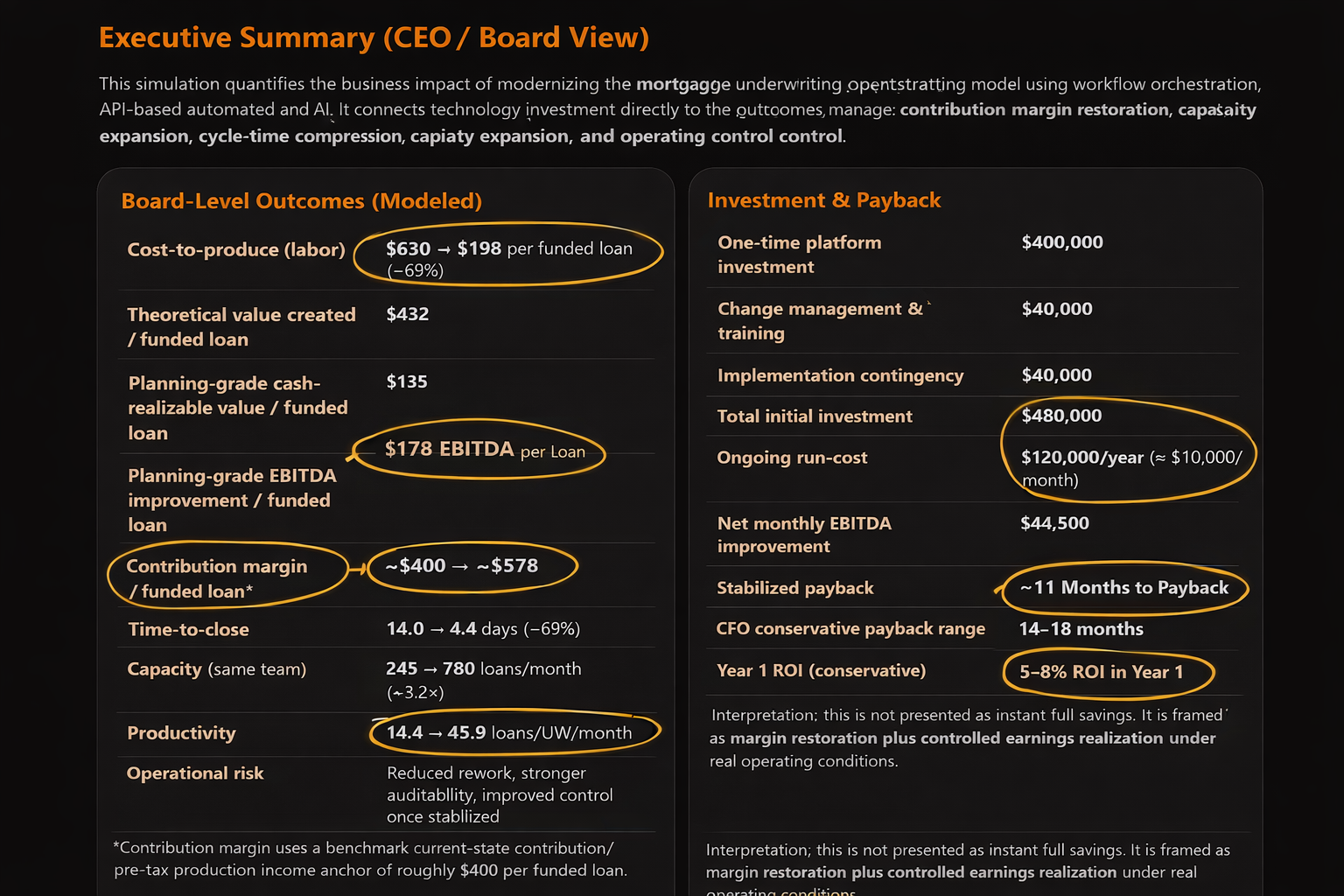
Shows what survives execution—what breaks, what holds, and what reaches earnings.
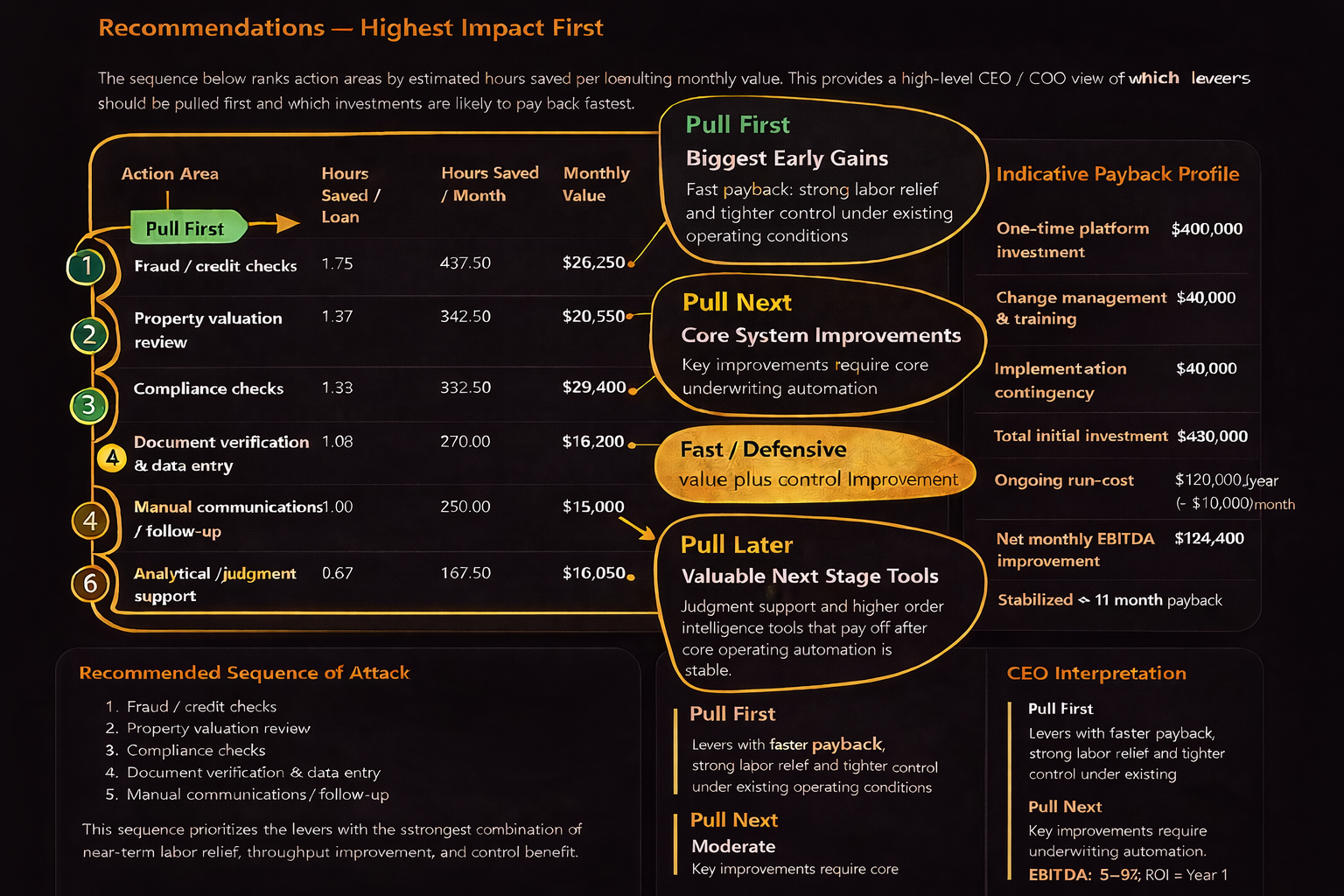
The simulation shows whether value reaches earnings. The playbook defines how to deliver it—what levers to pull, in what order, and where accountability sits.
Each lever maps to accountable ownership across Operations, Risk, and Finance to ensure improvements reach the P&L.
A board-level decision grounded in operating reality:
Leadership is not approving a plan.
They are approving how the enterprise will behave.
Without this level of validation, value fails to reach earnings:
Capital either compounds margin and speed—or increases coordination and control risk.
Initial mandates typically range from $45K–$230K depending on scope, enterprise complexity, and validation depth. Mandates are not projects. They are high-accountability operating interventions aligned to CEO and Board outcomes—restoring control, validating critical decisions, and sequencing trade-offs as autonomy scales.
Mandates are applied based on where leadership is in the decision cycle—from diagnosing structural constraints, to validating capital decisions, to restoring control as autonomy scales.
Strategic progression: diagnose structural constraints → validate capital decisions → restore control as autonomy scales.
In most enterprises, performance is constrained by the operating system—not strategy. This calibration identifies where execution is slowing, where margin is leaking, and where structural constraints are preventing transformation from converting into earnings.
Before committing more capital to transformation programs, automation initiatives, or organizational restructuring, leadership often needs clarity on a fundamental question: Why is the enterprise underperforming despite strategy, capital investment, and transformation already underway?
When performance does not match the level of investment, additional capital decisions become high-risk.
Outcome: Leadership leaves with a clear, defensible view of:
Why this is used:
Best used when the business should be performing better than it is, but leadership needs clarity before committing additional capital. Delaying clarity increases the cost of correction—and the risk of further misallocated capital.
This is not a prompting tool. It is an operating model simulator. Typically applied to capital decisions in the $5M–$250M+ range—where being wrong is materially more expensive than being precise.
Outcome: Leadership receives defensible, board-ready economics to support capital allocation decisions under real operating conditions. Typical duration: Designed for decisions that cannot wait for another transformation cycle.
Used when the question is “Where do we invest first?”—not “Can we improve this workflow?”
Not used for exploratory analysis. Applied when capital decisions are real and consequences are material. If a capital decision needs to hold under real conditions, this is where we start.
When to use: Used when execution integrity is degrading and leadership is losing control of performance.
Used when coordination cost, rework, and decision latency are already compressing margin.
When to use: Used in complex, multi-function enterprises (often $500M+ revenue).
Some enterprises cannot restore control without embedded leadership during critical stabilization windows where execution risk is material.
Not advisory. Not transformation planning. Applied when execution failure has economic consequence.
Applied across global enterprises in regulated, capital-intensive, and board-governed environments where execution failure carried direct consequence for earnings, capital deployment, and operational continuity.
XEOS is the business operating architecture used to rewire how enterprises execute as autonomy scales. It defines how decisions are made, how work moves, and how control is maintained when execution shifts from human coordination to machine-speed systems. XEOS is not a transformation framework. It is the operating system layer that ensures autonomy improves performance instead of introducing volatility into margin, cost, and earnings.
Enterprises were built on three visible layers of control: strategy, operations, and governance. As automation, AI, and autonomy move into core execution, those layers are no longer sufficient on their own.
The issue is not capability. It is that coordination-based operating models cannot govern execution at machine speed.
A fourth layer is required — the enterprise operating system — which determines how decisions, workflows, control signals, and accountability function at machine speed. XEOS is the business operating architecture for that layer.
Strategy still matters. Governance still matters. But execution has changed.
Without a defined operating layer, autonomy amplifies fragmentation instead of performance.
As autonomy scales, a consistent failure pattern emerges: decisions slow, exceptions increase, coordination cost rises, and execution fragments across systems.
Many enterprises are investing in transformation, automation, and AI — yet execution feels heavier, not faster. Decision latency increases. Coordination cost rises. Headcount does not reduce as expected. Initiatives fail to scale beyond pilots.
The issue is not capability. It is operating design. Most enterprises are attempting to scale autonomy inside systems designed for coordination, where decisions, workflows, and control still depend on human mediation.
XEOS identifies where the enterprise is structurally slowing itself down and establishes the decision rights, control architecture, and execution discipline required for autonomy to scale without degrading performance.
Unlike traditional approaches, XEOS does not coordinate execution around the work. It governs decisions, workflows, and control signals inside execution itself — where outcomes are actually produced.
In practical terms, XEOS helps leadership answer questions like:
Identifies where execution instability is building before it appears in earnings variance, missed expectations, or leadership surprises.
Exposes where coordination cost, rework, exception handling, and fragmented execution are preventing margin improvement from actually reaching the P&L.
Clarifies which transformation, automation, and AI investments are compounding enterprise performance — and which are diluting it.
Shows where decision latency, workflow seams, and fragmented authority are preventing the enterprise from moving at market speed.
Makes hidden execution risk visible before it becomes a governance issue, a regulatory issue, or a board-level concern.
Establishes explicit control signals so autonomy improves performance instead of introducing instability, blind spots, and unmanaged exposure.
The XEOS architecture below shows how decision authority, workflow coordination, and governance operate together when execution moves at machine speed.
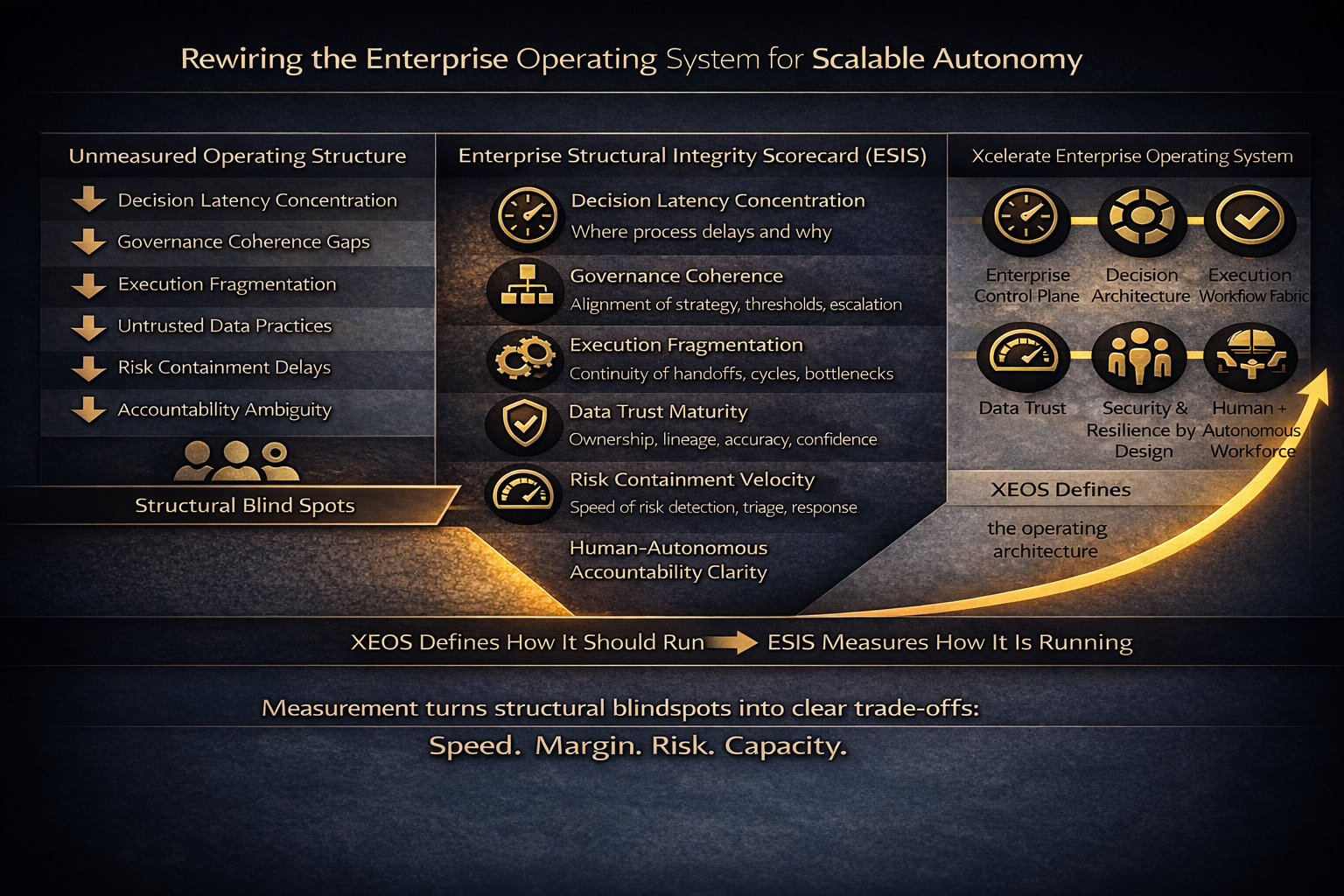
XEOS organizes enterprise execution into six control domains required to scale autonomy without introducing instability into earnings, margin, or governance.
These domains do not operate as overlays. They function as a unified control architecture governing execution in real time.
Operating Model Readiness is the mandated entry phase. Before autonomy expands further, we establish baseline execution signals, clarify decision rights, and define guardrails. Only then is rewiring sequenced.
Together, these control domains establish the business operating architecture required for policy-governed execution. The result is an enterprise capable of operating at machine speed without sacrificing leadership control, earnings reliability, or governance integrity.
Enterprise Visibility
Continuously monitors execution health — friction, throughput, exception load, and emerging risk — so leadership can see where autonomy is improving performance and where it is creating instability.
CEO value: Earlier intervention. Fewer surprises in operating performance.
Decision Authority & Escalation
Defines decision rights, confidence thresholds, escalation paths, and human override so autonomy operates within explicit leadership control.
Board value: Clear accountability and defensible governance.
Enterprise Execution Coordination
Aligns strategy to execution by coordinating workflows across functions, systems, and autonomous agents.
Operator value: Fewer handoffs. Measurable cycle-time compression.
Decision-Grade Data
Defines ownership, lineage, shared definitions, and quality gates so enterprise decisions are based on trusted signals.
CEO value: Higher confidence in capital allocation and operating metrics.
Autonomy-Scale Risk Containment
Establishes controls suited for machine-speed operations with auditability, containment, and recovery built into execution.
Board value: Reduced blast radius and faster recovery.
Accountability in Hybrid Execution
Defines how human judgment, exception handling, and accountability evolve as autonomous agents take on more execution responsibility.
CEO value: Lower coordination cost as scale increases.
Execution Stabilization activates the XEOS operating system inside the enterprise. ESIS then measures whether that operating system remains structurally healthy as autonomy scales.
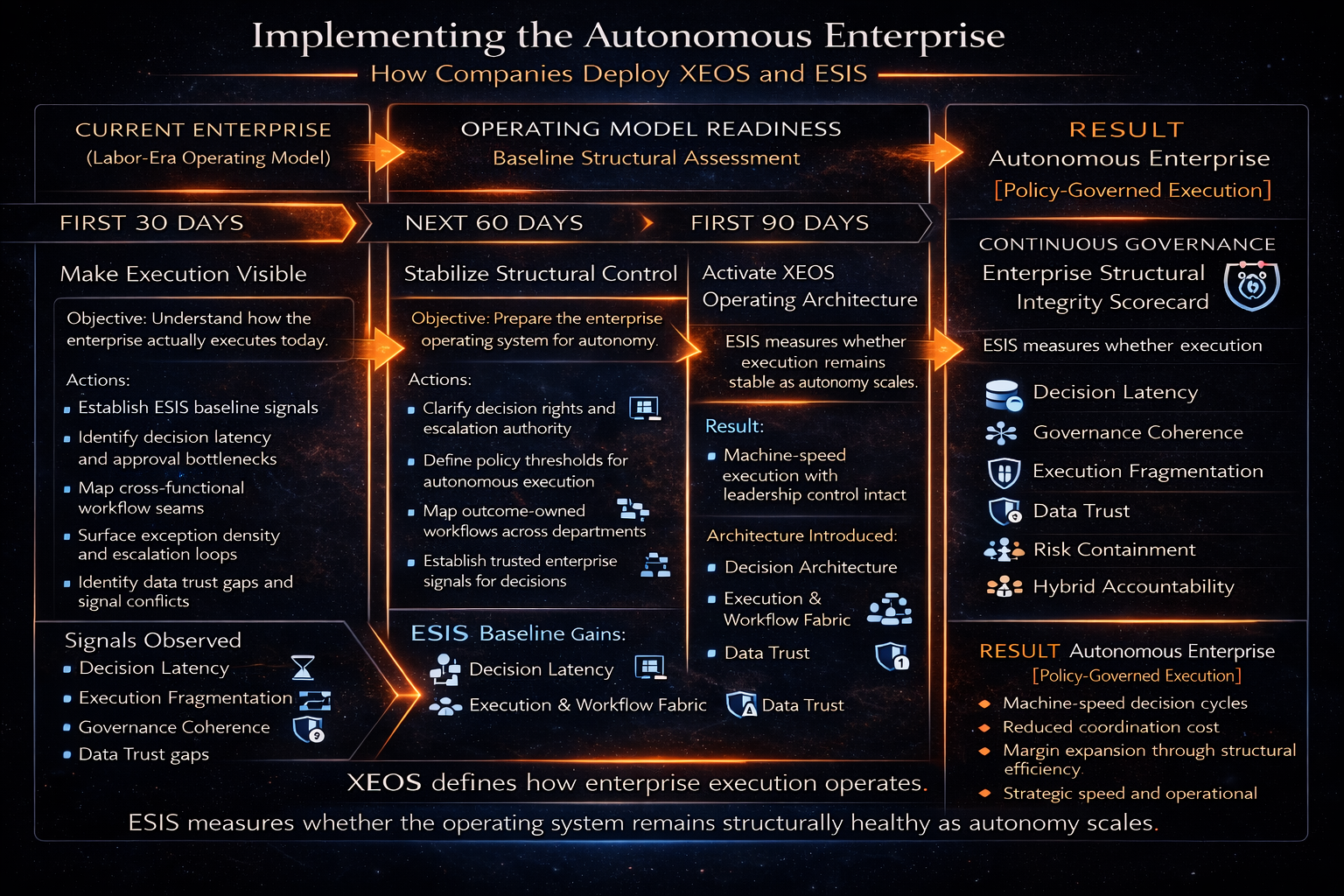
Execution Stabilization establishes the operating system for autonomous execution. ESIS ensures that operating system remains structurally healthy as autonomy scales.
Together they create the business operating architecture, measurement discipline, and feedback loop required to scale autonomy without losing control.
ESIS quantifies execution risk and value-at-risk as autonomy scales, allowing leadership to see structural weakness early enough to intervene before volatility reaches earnings, governance, or regulatory attention.
Measurement converts operating debate into explicit trade-offs across speed, margin, risk, and capacity.
ESIS converts execution risk into control signals across speed, margin, risk, and capacity.
ESIS measures six structural signals that indicate whether enterprise execution is operating with control or quietly degrading as scale increases.
Where the enterprise slows down
Measures where decisions accumulate delay across approvals, escalations, and workflow handoffs.
CEO signal: strategy is clear but execution is slow.
Who actually has authority
Measures whether decision rights, escalation paths, and authority thresholds are clearly defined and consistently applied.
Board signal: clear accountability versus hidden decision conflict.
Where productivity leaks
Measures seams, rework loops, exception density, and coordination cost across the enterprise.
CEO signal: structural drag preventing margin expansion.
Whether decisions are based on reliable signals
Measures ownership, lineage, shared definitions, and quality gates across enterprise data.
CEO signal: confidence in operating metrics and capital allocation.
How quickly problems are contained
Measures the speed of detection, escalation, containment, and recovery when execution deviates.
Board signal: resilience before incidents reach governance attention.
Ownership in human + autonomous execution
Measures whether exceptions, overrides, and outcomes have clear ownership as autonomy expands.
CEO signal: autonomy scaling without management blind spots.
Most transformation programs upgrade business systems while the enterprise operating system remains fragmented. When autonomy scales, fragmentation turns into volatility. Capital flows into capability without corresponding control — and the consequences surface later in margin, cost-to-serve, and risk exposure.
It is from labor-driven coordination to machine-speed decision systems governed by explicit control.
Labor absorbs friction. Machines amplify it.
Without defined decision rights, control signals, and governance architecture,
faster execution does not improve performance. It increases volatility, coordination cost, and earnings risk.
Boards do not buy frameworks. They want evidence that autonomy is operating with control. This governance discipline turns XEOS and ESIS into a leadership control system — making it visible whether autonomy is improving performance or quietly increasing exposure.
XEOS defines the business operating architecture. ESIS measures its integrity. Governance discipline ensures leadership acts on ESIS signals before execution risk reaches earnings.
Autonomy often improves local productivity while quietly increasing enterprise-level risk. Without explicit governance, decision delay, exception load, and policy drift accumulate beneath the surface until performance volatility reaches the P&L.
Governance discipline ensures leadership sees structural risk early — while it can still be corrected.
“AI adoption looks strong” while decision delay, exception load, policy drift, and structural risk accumulate beneath the surface. Governance discipline makes value erosion visible early — before it reaches earnings or regulatory exposure.
An ESIS baseline is established early and tracked over time so leadership can see whether execution integrity is improving or degrading as autonomy expands.
A small set of measurable signals is monitored across speed, margin, risk, and capacity to show where the operating system is holding and where it is drifting.
Leadership needs proof that autonomy is operating within explicit authority and defensible control — not just producing local performance gains.
A monthly executive forum turns measurement into action before operating issues become financial issues.
The governance process produces concise, defensible materials for leadership and board oversight — including ESIS trends, exposure hotspots, mitigation priorities, and autonomy guardrail status.
Autonomy without governance converts operating leverage into earnings volatility.
Two paths can look similar at first. Both pursue autonomy. The difference is how governance scales with execution — and whether the enterprise absorbs or avoids the cost of control failure as autonomy expands.
Year 1 — Optics + Early Wins
Economic signal: Visible improvement in operating leverage.
Year 2 — Friction Risk Emerges
Economic impact: Supervisory layers expand. Rework rises. Coordination cost increases. The first signs of the cost of control failure begin to surface.
Year 3 — Variance + Capital Drag
Economic outcome: ROIC softens as volatility and control costs rise. The enterprise pays a recurring tax for scaling autonomy without proportional governance.
Year 1 — Control Architecture Established
Economic signal: Acceleration with bounded risk.
Year 2 — Stability + Efficiency Gains
Economic impact: Lower coordination cost. Reduced supervisory drag. Control reduces the emerging cost of volatility.
Year 3 — Durable Economic Advantage
Economic outcome: Higher earnings quality, lower variance, stronger regulatory defensibility, and capital efficiency that sustains valuation resilience across cycles.
This is not a choice between short-term wins and long-term resilience. It is a capital allocation and sequencing decision under pressure. CEO pressure is real. Quarterly optics matter. Boards must also manage earnings durability, regulatory exposure, and cost of volatility. Rapid AI deployment can generate visible acceleration. But when autonomy scales faster than governance capacity, enterprises incur the cost of control failure — rising rework, supervisory drag, remediation investment, earnings variance, and regulatory scrutiny. The disciplined path is not slower. It is structurally governed. Autonomy expands only where decision rights, control signals, auditability, and escalation authority are explicit. Enterprises that combine acceleration with structural discipline convert operating leverage into durable ROIC — instead of volatility.
Autonomy without governance converts operating leverage into earnings volatility.
Xcelerate Innovation is an enterprise operating system company. We help CEOs and Boards diagnose structural execution constraints, validate capital decisions under real operating conditions, activate the XEOS operating architecture, and govern performance through ESIS as autonomy scales.
Enterprises do not lose because they “miss AI.” They lose because autonomy is deployed into operating systems built for human coordination. As execution shifts to machine-speed decision systems, structural weaknesses that were previously absorbed by labor become amplified—impacting margin, risk, and capital productivity.
Todd Bell leads this work as Chief Enterprise Execution Officer/COO.
Trusted in environments where execution failure cannot be absorbed.
He operates inside complex enterprises where execution breakdowns materially affect earnings, risk exposure, and capital allocation—often under board visibility, regulatory constraint, or time-critical conditions.
For almost 20 years, his work has spanned global enterprises across healthcare, insurance, payments, energy, travel, consumer industries, and regulated infrastructure—frequently in environments where authority is distributed, systems are fragmented, and execution must be stabilized without disrupting live operations.
Selected Roles & Operating Authority
The work focuses on restoring execution control—ensuring enterprise performance remains stable, measurable, and economically aligned as autonomy scales.
Questions CEOs and leadership teams ask before autonomy enters core operations.
Without control, additional capability increases complexity, cost, and volatility instead of performance.
Early gains can mask structural drift. Over time, competitors built for autonomy widen the gap. This work makes that erosion visible early—while it is still reversible.
Siloed data, unclear decision rights, and brittle workflows amplify instability.
The issue is not AI performance. It is operating design. Control must be restored first—governance, signals, and structural integrity—so autonomy can scale without eroding margin.
We deploy XEOS, measure execution integrity through ESIS, and apply executive operating mandates where control must be restored under real economic consequence.
The work combines operating architecture, decision simulation, activation, and governance so autonomy improves performance instead of introducing volatility.
As decision rights, control signals, and escalation pathways are tested, sequencing changes. A monthly mandate preserves flexibility while keeping accountability tied to outcomes—speed, margin, and risk—not deliverables.
The objective is not total automation—it is controlled, economic deployment.
Workflows should be sequenced based on economic impact and control readiness. A workflow may begin at 30% automation and scale to 50%+ as governance, decision rights, and execution stability mature.
This work is best suited for environments where autonomy is entering core operations and execution must be governed across speed, margin, risk, and capacity.
A baseline ESIS, initial control signals, defined decision rights and escalation, and a sequenced roadmap showing what to advance, pause, or redesign—before instability reaches earnings.
Decision rights, guardrails, sequencing, and evidence are made explicit so internal teams and partners execute within a coherent operating model.
XEOS does not start with clean-up. It establishes a control plane—making fragmentation visible, quantifying its impact, and sequencing rewiring based on structural leverage.
Decision rights are clarified before redesign. Control signals are established before tools are replaced. Structural coherence is created—not assumed.
This occurs in high-consequence environments where trade-offs, escalation, and execution control must be owned directly to be effective.
Prepay removes administrative friction and prevents time-based incentives from distorting execution.
Discretion is frequently required—especially where governance connects to earnings volatility, regulatory exposure, or capital allocation. An anonymized portfolio can be shared where appropriate.
Short executive perspectives on autonomy, operating control, and enterprise performance as AI moves into core operations.
Featured Executive Briefing
AI Demonstrations vs. Enterprise Reality
AI demonstrations typically show a clean workflow executing from start to finish. Enterprise operations rarely behave that way. Real workflows cross multiple systems, departments, and policy boundaries. Data is inconsistent. Exceptions are common. Humans have historically absorbed that complexity through coordination — calling someone, fixing the data, escalating a decision, or manually bridging systems that do not align. AI does not remove those conditions. It simply executes the standard cases faster, leaving the remaining work concentrated in exceptions.
When AI accelerates execution inside fragmented operating models, the remaining work concentrates in exceptions, oversight, and remediation — increasing supervisory load instead of reducing it. Exception queues grow, supervisory layers expand, and organizations quietly reintroduce humans as buffers. This is why many companies experience automation without the margin improvement or headcount reduction they expected. The technology is not the constraint. The enterprise operating system underneath it is. Enterprises that scale autonomy successfully address that structure first — clarifying decision rights, governance signals, and workflow control — so automation improves performance instead of exposing instability.
We are seeing economic recalibration driven by a confluence of factors, including margin pressure, rising capital costs, and the need for greater operational efficiency.
Read on LinkedInIn unforgiving margin environments, autonomy without operating control becomes volatility—not leverage.
Read on LinkedInHeadcount cuts can create short-term optics while increasing medium-term operational and governance risk.
Read on LinkedInWhy enterprises lose earnings quality when autonomy scales faster than operating control.
Enterprises are not failing because of AI. They are failing because their operating systems cannot support machine-speed execution. This is not incremental improvement. It is economic survival.
When AI Meets the Wrong System defines why organizations fail structurally—not technologically—as autonomy scales across the enterprise.
Todd Bell delivers executive briefings and keynotes for CEOs, boards, and leadership forums on how enterprise operating systems fail—and how to restore execution control—as AI and autonomy scale, based on When AI Meets the Wrong System.
CEOs and Boards typically reach out when one or more of these conditions appear:
This site is protected by reCAPTCHA and the Google Privacy Policy, Terms of Service apply.